F-1 Visa Interview Questions and Answers
What consular officers ask F-1 applicants — and how to prepare under the tougher 2026 screening rules.
Last updated: June 2026
About this guide
International students interested in studying in the United States do not have it easy. Not only do you have to worry about being accepted into a desirable and competitive program at a US college or university, you also have to convince the US government to grant you an F-1 student visa in order to pursue your studies. This guide walks you through the five categories of questions consular officers ask, with sample questions and answering tips for each — updated for the major policy changes of 2025–2026, including mandatory in-person interviews, expanded social media vetting, new fees, and pending changes to how long students may stay. It draws on official guidance from the , , and the .
Key takeaways at a glance
- Interviews are mandatory again. Effective October 1, 2025, nearly all F-1 applicants — including renewals — must attend an in-person visa interview, after the Department of State rolled back pandemic-era interview waivers. (Source: )
- Your online presence is part of the file. All F, M, and J applicants must disclose social media accounts on the DS-160 and set their profiles to public for consular review. (Source: )
- A Green Card petition no longer automatically sinks F-1 status. The USCIS Policy Manual confirms a student may be the beneficiary of a permanent labor certification or immigrant petition and still demonstrate intent to depart. (Source: )
- Duration of Status may be ending — but not yet. A DHS final rule that would cap admission at a fixed period of up to four years went to OMB review in May 2026; until it is published and takes effect, D/S still applies. (Source: )
-
What changed for F-1 applicants in 2025–2026
During the F-1 visa application process, international students are put through a visa interview in English, which can be intimidating for English as a second language speakers. While widespread interview waivers were available in previous years, the U.S. Department of State , making in-person attendance mandatory for the vast majority of first-time and renewing F-1 applicants. Knowing what to expect before you walk in has never mattered more.
The four changes that affect your interview
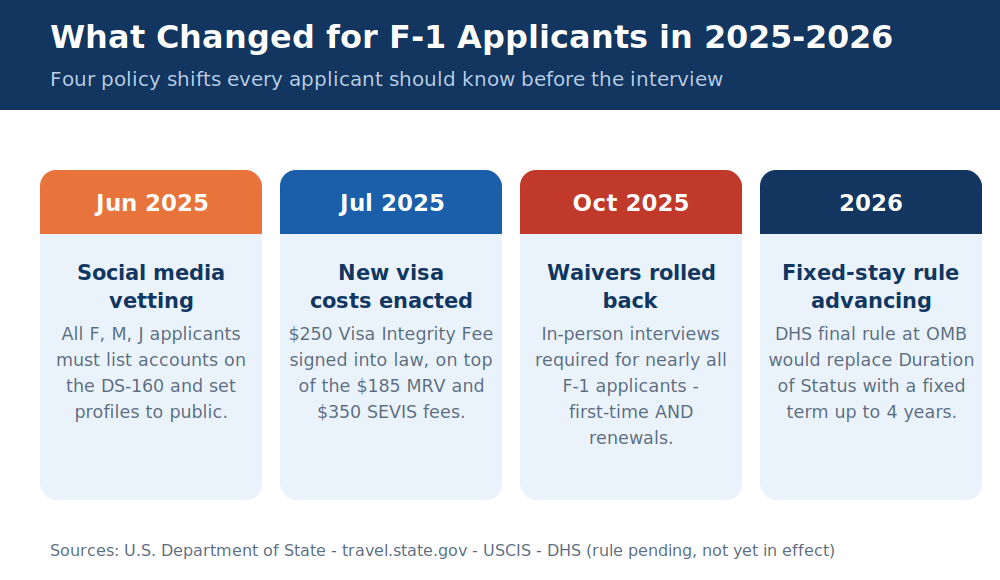
- In-person interviews are required. Nearly every F-1 applicant must now appear before a consular officer, including students renewing a visa in the same classification. Appointment wait times have grown as a result, so schedule as early as your I-20 allows.
- Expanded screening and vetting. Under the State Department's , consular officers conduct a comprehensive review of each applicant's online presence. You must list your social media identifiers on the DS-160 and set your profiles to public — and the program has since .
- New costs. On top of the $350 SEVIS I-901 fee and $185 application fee, a Visa Integrity Fee of at least $250, payable at visa issuance, was enacted into law in July 2025 (Public Law 119-21). Confirm its current collection status with your consulate when you apply.
- Length-of-stay rules are in flux. DHS is finalizing a rule to replace the flexible "Duration of Status" framework with a fixed admission period of up to four years (covered in the post-graduation section below). It is not yet in effect.
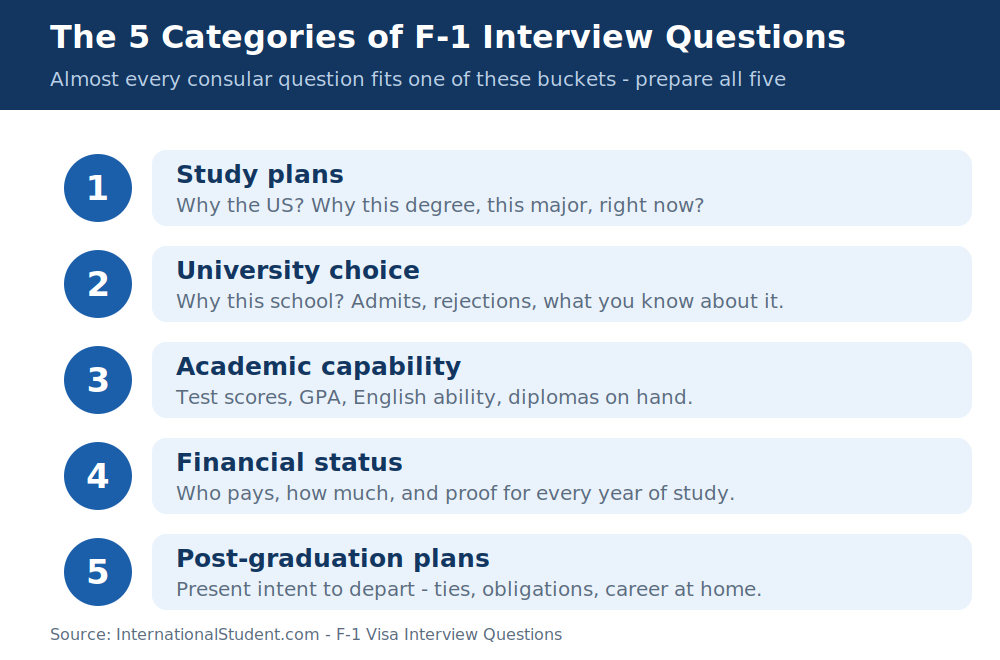
Below are sample questions the visa officer might ask in each of the five core categories, and tips on how to answer them. If after reviewing this information you think you need personalized guidance, explore one-on-one help and mock interview practice, or consider consulting an immigration law firm.
-
Questions about your study plans
These questions will be similar to your university application essays and interviews. Simply enough, officers are interested in your choice of pursuing higher education rather than joining the workforce, and in your choice to study in the US versus your home country or any other place. Lead with a specific, genuine reason this program fits your goals.
Sample questions
- Motivation. Why do you want to study in the US? Why are you planning to continue your education in the United States? Can you not continue your education in your home country?
- Program fit. What will you specialize in for your degree? What will be your major? How will this study program relate to your past work or studies?
- Background. Where did you go to school before now? Who is your current employer? What do you do?
Learn about the variety of degree programs available in the USA
-
Questions about your university choice
Similar to your study plans, the university you will attend is of interest to the interviewer. These questions will look to shed light on your qualifications as a student and future professional, and on whether you researched your decision seriously. Be ready to talk about your school specifically — its program, faculty, and location.
Sample questions
- Your application record. How many colleges did you apply to? How many schools admitted you? How many rejected you? Answer honestly — officers can sense rehearsed perfection, and rejections are not disqualifying.
- Your knowledge of the school. Do you know your professors at that university? What are their names? What city is your school located in? What do you know about the local area?
- Your history with the US. Have you been to the US before?
-
Questions about your academic capability
Not surprisingly, you will need to prove your capability to succeed in a US university during your interview. Your test scores, previous GPA, and previous study abroad can all be evaluated to determine your likelihood of success during your program. Remember the interview itself is conducted in English — it doubles as an informal language test, so practice speaking, not just memorizing answers.
Sample questions
- Scores and records. What are your test scores (GRE, GMAT, SAT, TOEFL, IELTS)? What was your previous GPA? Can I see your high school or college diploma?
- Readiness. How will you manage the cultural and educational differences in the US? How good is your English?
- Comparative choice. Why do you want to pursue a degree in the US? Why not study in Canada, Australia or the UK? What do you know about US schools?
Learn more about the types of test scores accepted by US schools
-
Questions about your financial status
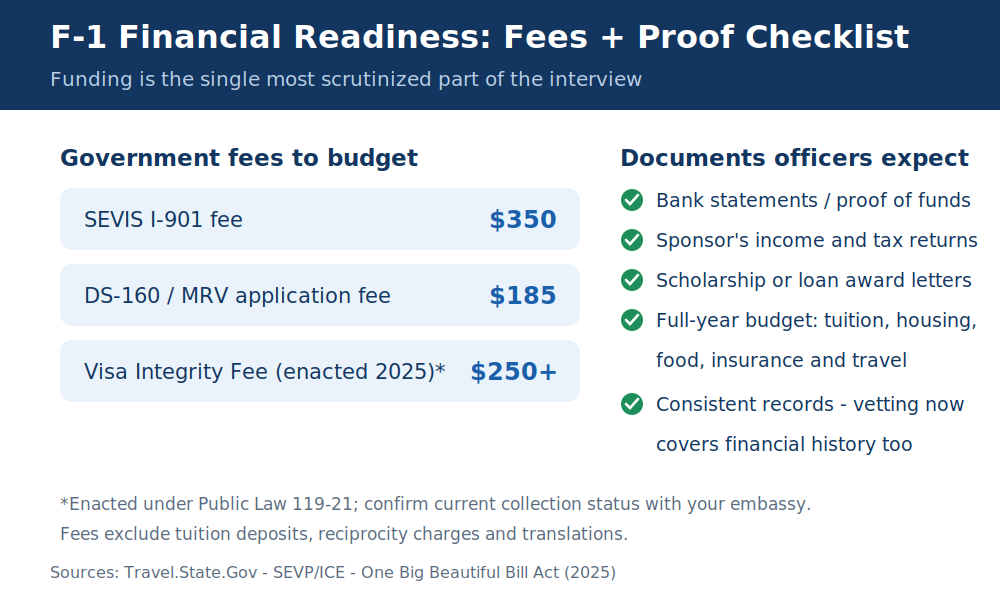
This is the most important piece of obtaining your F-1 visa. Regardless of your academic qualifications, you cannot be awarded an F-1 student visa if you cannot demonstrate that you will be able to finance your education. The cost of education in the US is much higher than in other countries, so it is important to investigate and have a solid financial plan. This plan should include more than just tuition expenses — consider housing, food, transportation, , and all other relevant expenses. Additionally, be prepared for stricter scrutiny of your records and background: under the State Department's , authorities now routinely review background elements — including your online presence and the consistency of your financial documentation — when evaluating eligibility.
Sample questions
- Income and sponsorship. What is your monthly income? What is your sponsor's annual income? Who is going to sponsor your education? What is your sponsor's occupation?
- Cost and coverage. How much does your school cost? How do you plan to fund the entire duration of your education? How will you meet these expenses? How else will you cover the rest of your costs?
- Documentary proof. Do you have a copy of your bank statements? Can I see your tax returns? Did you get offered a scholarship at your school?
Budgeting for the new fees
- Plan for at least $535 in government fees — the $350 SEVIS I-901 fee (paid via ) plus the $185 DS-160 application (MRV) fee — and budget for the Visa Integrity Fee of at least $250 enacted under Public Law 119-21, payable when the visa is issued. Implementation of the integrity fee has been phased, so confirm the current amount and collection process with your embassy or consulate.
-
Questions about your post-graduation plans
Technically, the F-1 student visa is granted based on your present intent to depart the United States after completing your studies. Although it is not impossible to stay in the US after graduation through programs such as OPT and H-1B, it will be important for you to prove at your interview that you have ties and obligations — including family, property, or a job offer — that support your return to your home country.
What the current rules actually say
- A pending Green Card petition is not an automatic disqualifier. Official guidance in the clarifies that a student may be the beneficiary of a pending or approved permanent labor certification or immigrant visa petition and still demonstrate the intention to depart after a temporary period of stay — giving students a much clearer pathway to transition safely while maintaining valid F-1 status (see this ). Keep in mind this is USCIS policy for maintaining status inside the US; at the consulate, the officer will still assess your present intent under the law, so answer truthfully about your plans.
- The "Duration of Status" framework may be replaced. The Department of Homeland Security has moved to eliminate the long-standing Duration of Status (D/S) system and replace it with a fixed admission period of up to four years, meaning extensions for further study or OPT would require formal USCIS applications. The but is not yet in effect — D/S remains the rule today. Check with your Designated School Official (DSO) for the latest before you travel or extend.

Sample questions
- Connections. Do you have relatives or friends currently in the US?
- Plans. What are your plans after graduation? Do you have a job or career in mind after you graduate? Will you continue to work for your current employer after you graduate?
- Intent. Do you plan on returning to your home country? Are you sure you won't stay in the US?
It is important to remember during your F-1 visa interview to remain calm! Being well prepared is extremely important. Be sure to have all of the required documents and receipts with you so that you can focus on your interview questions. Answer all of the questions asked of you, and remember to be open and honest.
Learn about and what to expect after graduation.
-
Quick reference: old rules vs. new rules
The fastest way to see how the ground has shifted for F-1 applicants between the pandemic-era flexibilities and today's standards.
Key F-1 policy shifts, 2025–2026 Policy area Old framework New standard (2026) Interview waivers Extended "dropbox" waivers for many renewals and low-risk applicants Significantly reduced effective October 1, 2025; in-person interviews required for nearly all F-1 applicants, including renewals Immigrant intent A Green Card or labor certification filing widely treated as fatal to F-1 eligibility USCIS Policy Manual explicitly allows students to be beneficiaries of immigrant petitions while maintaining F-1 status, if present intent to depart remains Length of stay Duration of Status (D/S) — valid as long as you maintain your program Final rule pending (OMB review since May 2026) to impose a fixed term of up to 4 years with USCIS extension filings; D/S still applies until the rule takes effect Background vetting Standard document and database checks Mandatory social media disclosure on the DS-160, public profile settings, and comprehensive online-presence review for all F, M, and J applicants -
Frequently asked questions
Direct answers to the questions F-1 applicants ask most about the interview under the current rules.
Do I still qualify for an F-1 interview waiver (dropbox) in 2026?
- Almost certainly not. Effective October 1, 2025, the U.S. Department of State rolled back the interview waiver program, so nearly all F-1 applicants — first-time and renewing — must attend an in-person interview with a consular officer. The remaining waiver categories are limited mainly to diplomatic and official visa classifications and certain B-1/B-2 renewals, so plan for an interview and book your appointment early, since wait times have grown.
Will the visa officer check my social media before my F-1 interview?
- Yes. Since June 2025, the Department of State conducts a comprehensive online-presence review of all F, M, and J visa applicants. You must list your social media identifiers from the past five years on the DS-160 form and are instructed to set your profiles to public. Review your online presence before applying, be consistent with what is in your application, and avoid abruptly deleting accounts, which can raise questions.
If someone has filed a Green Card petition for me, can I still get or keep F-1 status?
- Inside the United States, yes — the USCIS Policy Manual clarifies that being the beneficiary of a pending or approved permanent labor certification or immigrant petition does not automatically disqualify you from F-1 status, as long as you intend to depart when your authorized stay ends. At the consular interview, however, you must still convince the officer of your present intent to leave after your studies, so be honest and emphasize your ties and obligations at home.
Is the fixed four-year F-1 stay rule already in effect?
- No. As of June 2026, Duration of Status (D/S) still applies — you remain in status as long as you maintain your program. DHS sent a final rule to the Office of Management and Budget in May 2026 that would replace D/S with a fixed admission period of up to four years and require formal USCIS extensions, but it does not take effect until it is published in the Federal Register and its effective date passes. Watch for updates from your Designated School Official (DSO).
How much does the F-1 visa application cost in 2026?
- Budget at least $535 in government fees: the $350 SEVIS I-901 fee plus the $185 DS-160 (MRV) application fee. A Visa Integrity Fee of at least $250, payable at visa issuance, was also enacted into law in July 2025 — confirm its current collection status with your embassy or consulate, since implementation has been phased. These figures exclude tuition deposits, document translations, travel, and any country-specific reciprocity fees.
Want more guidance on getting your F-1 visa to the United States approved? You can get one-on-one guidance and mock interview practice — learn more about personalized F-1 visa help. Watching a live simulation can also demystify the process: this breaks down how applicants navigate the tougher questions about long-term intent and home-country ties under the current scrutiny.
Guidance current as of June 2026. Immigration policy is changing quickly — verify details with the primary sources below and your Designated School Official before acting.
Official resources: | | |